
Nicolaas Hartsoeker · Paris, 1694
Essay on Dioptrics
The 1694 treatise on light, lenses, vision and the heavens — translated from the French, in English for the first time.
Translated with commentary by Claude, an AI model made by Anthropic
Edited by Dominic Ouryan Grayson
Reader's Edition · 6 × 9 in · paperback ISBN 979-8-9983275-1-3 · hardcover ISBN 979-8-9983275-0-6 · published by Homunculus Cabinet
The book
In 1694 a Dutch lens-grinder living in Paris published a book explaining how light bends, how the eye sees, what the moon is made of, and what he had found swimming in a drop of seed. It has never appeared in English. This is that translation.
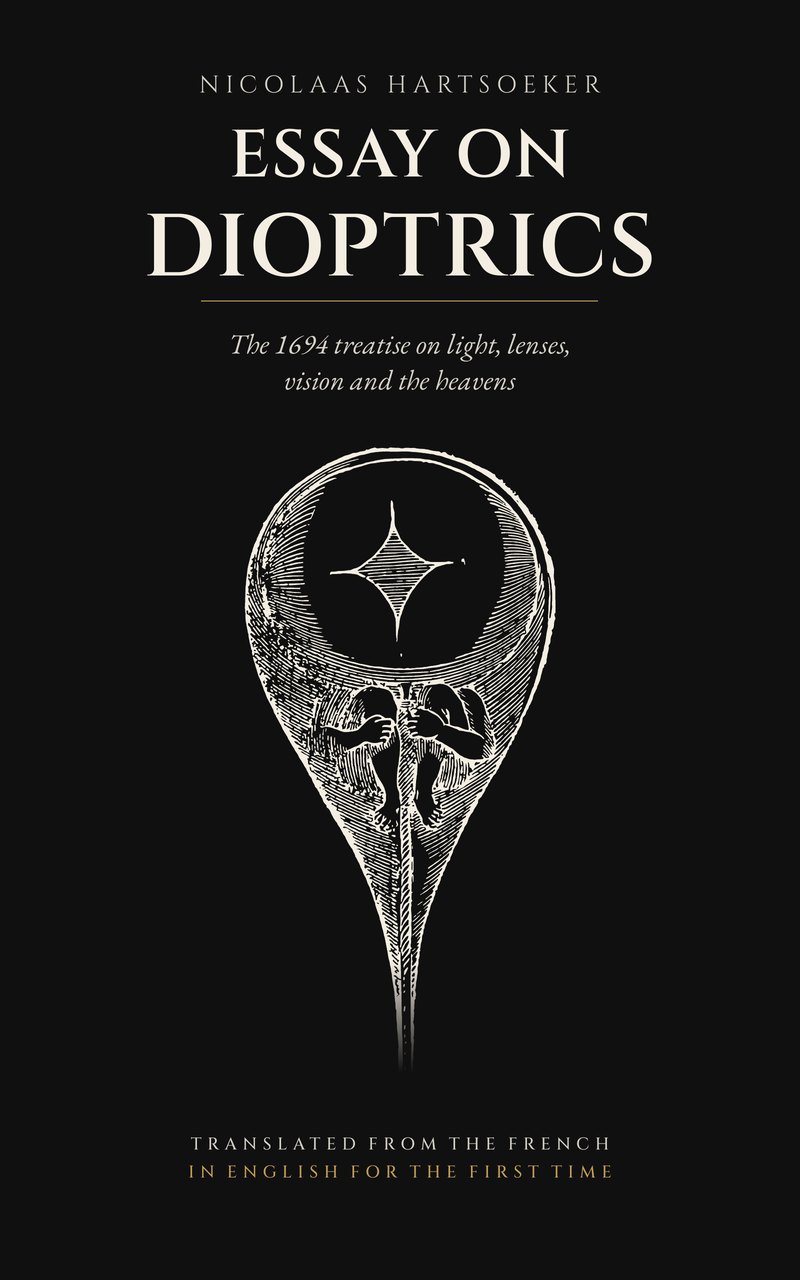
Nicolaas Hartsoeker ground his own glass, built his own instruments, and argued with Huygens and Leeuwenhoek as an equal. His Essay sets out an atomic theory of light; nineteen geometrical propositions that contain — written as proportions, because he had no algebra to write them with — the lensmaker's formula, the thick-lens formula and the nodal points of a lens; the eye as a darkened room; a map of the moon whose craters he takes for dug cities and whose bright rays he takes for roads; and the drawing on the front of this book, the most reproduced image in the history of embryology.
The translation was made from the page images of two copies of the first edition. Every proposition in the geometrical chapter has been checked against modern optics, and the places where the 1694 printing is wrong are identified and explained. A reader's primer explains the optics from the beginning; nothing beyond arithmetic is assumed.
If one could see the little animal through the skin which hides it, we should see it perhaps as this figure represents it. Chapter X, Article LXXXIX
What is in it
- I–III. Light and matter: hard atoms swimming in a fluid, how the earth and its air settled out of them, why some bodies are fluid, opaque or transparent, and why light takes time to arrive.
- IV. Refraction and reflection: the law of sines, found by experiment to be very nearly 3 to 2; the colours, down to how scarlet is dyed; and the refraction of the air, with the Paris Observatory's table of it degree by degree.
- V–VII. The eye and vision: how small a thing the eye can make out, the eye as a darkened room, short and long sight, why we see things upright and single, how distance and size are judged, and why the moon looks larger at the horizon.
- VIII. Making lenses: the flaws in glass, and how to grind, smooth and polish everything from a great telescope objective to the smallest lenses.
- IX. Using lenses: nineteen geometrical propositions on where a glass brings light to a focus, the limit aberration sets on a telescope's aperture, with his table of apertures, and telescopes of two, three and four glasses and microscopes of one and two.
- X. What the instruments show: the moon, whose bright spots he takes for cities and its streaks for roads; Mars turning in 24 hours 30 minutes; Jupiter's bands and moons; Saturn's ring; sunspots; a long theory of comets and of the distance of the stars — and, at the end, the animalcules of the seed, with the drawing on the cover.
Two editions
They are two separate books, not two volumes of one. The translation in both is the same; what surrounds it is not.
The Reader's Edition
The complete translation, a primer that starts from nothing, the 1694 engravings with clean redrawings beside them, and notes where the 1694 page is wrong. Meant to be read straight through.
The Scholar's Edition
The same translation with its full apparatus: every reading and how it was taken from the page, the concordance of page numbers, a fuller comparison of two copies of the first edition, and the notes the Reader's Edition withdrew, each with its reason.
How it was made
From the page images of two copies of the 1694 printing: the Bibliothèque nationale de France copy and the Bibliothèque interuniversitaire de santé copy, both in Paris. Where the printing is doubtful, the reading was taken from the image of the page itself, not from a transcription, and the page is cited.
The geometrical propositions were checked by computation, not by eye: each one was reconstructed and tested against modern optics before the English was settled. Where Hartsoeker's arithmetic fails, the note says so and says by how much.
The translation, its notes, the introduction and the primer were made by Claude, an AI model made by Anthropic, under the direction of the editor, Dominic Ouryan Grayson. The book says so on its title page and prints a full account of how the work was done: what the machine did, what it got wrong, and how those errors were caught.
The editor does not read French, and no reader of French has yet checked the translation against the original. If you read French and check a passage, the editor would like to hear what you find; the address is at the foot of this page.
Engravings reproduced from the copy held by the Bibliothèque interuniversitaire de santé, Paris — Medic@, under the Licence Ouverte (Etalab).